
An Iyengar Yoga School

About the school
Class Times + Prices
Making up missed classes
About Iyengar Yoga
About your teachers
Before class
Contact
Links

The Iyengar Certification Mark
This is the certification mark used by Iyengar yoga teachers, entitling them to use the name of yoga master BKS Iyengar and his teaching method.

Phillip Island Yoga

Something brought you to this website about yoga. Maybe you are hoping to relieve a sore back, to achieve more flexibility and strength, maybe you are hoping to find some peace of mind.
There is a good chance that yoga may help with many of these things.
However, there is also the possibility that it will give you so much more.
About the school

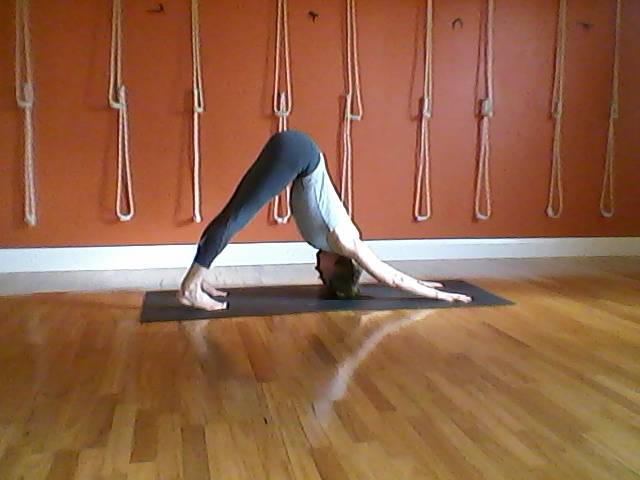
The school is located at
74 Ventnor beach Road, Wimbledon Heights, Phillip Island.

The room is fully equipped. It has a capacity of around 12 students, and most of the classes are run on a term basis, meaning that the same group progress together through a 10 week course. It also means that I generally don't have drop-in students, but if you are only here for a short time, give me a call, especially if you have prior experience.

We have heating and cooling, and a secure place to leave your bags. Parking is within our yard and on our very wide nature strip. Generally, it is a quiet area.

Timetable and Prices

MONDAY Beginners/Level One7:15am - 8:15am

Intermediate9:30am - 11:00am

Intermediate6:00pm - 7:30pm
TUESDAY Beginners with Melijah9:30am - 10:45am

Experienced6:00pm - 7:30pm
WEDNESDAYIntermediate9:30am - 11:00am

Intro to Level 1 with Deb5:00pm - 6:15pm

SEE BELOW for details and pricing.

(Please note: when terms differ in length from 10 weeks the term cost is altered accordingly. In some circumstances casual attendance is available for $25. Please contact me if you are hoping to attend a class casually.)

BEGINNERS class is suitable for people who have never stepped on to a yoga mat before. It is also suitable for students returning after a long break, injury or coming from other styles of yoga.
COST $170 for a 10 week term.

The LEVEL ONE class is suitable for those who have some yoga experience or have completed a Beginners course.
COST $200 for a 10 week term.

INTERMEDIATE is for students who have started to develop their inversions (headstand, shoulder stand, handstand). However, students with experience who can not do these asanas for medical reasons, or injury, are given supported alternatives.
COST $200 for a 10 week term.

EXPERIENCED class is for students who are confident with their inversions and have a regular practice.
COST $200 for a 10 week term.

LED PRACTICE is an opportunity for existing students to come together and practice. I lead the sequence, but do not teach or adjust, therefore, it is important that you have a knowledge of the asanas. $15 a class. You can also use this to make up for any missed classes of the same term.

SENIORS class is for anyone who needs to work with support. We use chairs, and usually only get down and up off the floor once in a class. $12 a class.

TERM DATES
Term 1:
Feb 3 (Mon) - 31 Mar (Mon)
Term 2:
28 Apr (Mon) - 4 Jul (Fri)
Term 3:
21 Jul (Mon) - 19 Sep (Fri)
Term 4:
6 Oct (Mon) - 16 Dec (Tue)

Making up missed classes

Because most students pay for a 10 week course up-front, I try to make it possible for you to make up any classes you miss in your course.

This can be done by attending another class in the week (please check with me that there is space) or by coming to Led practice. Make-up classes should be done in the same term that the class was missed.

In unforeseen circumstances, when a lot of classes are missed in a prepaid term (i.e. serious illness), I may calculate the cost of classes that were attended (at the casual rate), and give you a credit for the remainder in the following term. This credit will be deducted from the payment of the next course. It does not allow you to attend until the credit is consumed without re-enrolling.

Please understand that I am trying to be as fair as possible to you with regards to missed classes. However, I need to also be fair to myself. If you have enrolled in a course, I am holding a place for you in the room. Letting me know your changed circumstances as soon as possible, will lead to the best outcome for both of us.

About Iyengar Yoga

Iyengar yoga has been named after the man who developed this approach to hatha yoga, Mr BKS Iyengar (1918-2014). There is much written about Mr Iyengar and links to his story can be found on this website.

From an early age he started practicing yoga to regain health after a sickly childhood. Over many decades he explored the different aspects of yoga through countless hours of practice, self study, and study of the ancient texts. He realised the importance of aligning the body correctly in yoga postures (asanas) and therefore in every day life. He explored how asanas and pranayama (breathing practice) should be sequenced, and how they should be held or maintained, in order to best benefit the body and mind. Through this focus, he moved from observing the outer layers of the flesh and bones, towards the more subtle workings of the body(respiratory, nervous, endocrine,digestive, etc.), and how energy flows to, through, and out of the body. This also led him to observe the habits of the mind, and to appreciate what is even more subtle than the body and the mind, the soul or spirit. His years and years of experience and experimenting, built a wealth of knowledge, without the use of modern equipment such as MRIs and monitoring tools. He wrote books and taught thousands of classes, to attempt to pass this knowledge on. His son Prashantji and his daughter Geetaji, and now his grand daughter Abhijata, as well as many long term students, continue to pass down his knowledge.

In Australia we have senior Iyengar yoga teachers who have practiced in the method of Iyengar yoga for decades, studied with Mr Iyengar and the Iyengar family over the years, and in turn pass their knowledge on via teacher training. This is how a lineage is created. There is great care taken by the Australian Iyengar Yoga Association to not dilute the teachings, and that is why the teacher training and certification process is so stringent. You will never do “bad” yoga because you are stiff or old or injured. You will only miss out on the benefits if your mind wanders.

When you attend an Iyengar yoga class you will practice the asanas (and later pranayamas), that are common to many hatha yoga classes. However, you will be asked to use your body in very specific ways to aim for correct alignment. There are props, such as blocks and belts, to help you. This demands your complete attention, and therefore your mind starts to move inward and develop concentration. This inward focus can become ever more subtle over time, until the practice becomes a meditation in movement. The mental freshness that you feel after a class, is because the constant jumpiness of the mind from one subject to the next, is stilled, and the mind learns to stay present in the body. You will never do 
We do some strong asanas in an Iyengar yoga class. These include standing on our hands, our heads and our shoulders. However, these are asanas that we build up to with time, and you will not be asked to try them if your body and mind are not ready.

About your teachers

FIONA RAWSON

My name is Fiona Rawson. I was drawn to yoga in my early twenties, and loved it so much I started a daily practice almost from the outset. After a few years, friends started asking me to teach them some asanas. Eventually, they suggested I should do a teacher training course. I traveled to Melbourne over a two year period and completed a hatha yoga teaching certificate. During that course, guest teachers would take a class to increase our exposure to different types of yoga. One of those teachers was Peter Scott, who introduced us to Iyengar Yoga. I had owned the book "Light on Yoga" for a few years, and often worked from it. However, that day I realised the enormous depth and huge knowledge base of Iyenger Yoga. I was hooked.

After a number of years attending classes at Peter's school in Carlton, he accepted me as a teacher trainee, and I started my training again. It was an apprenticeship style of course, so when Peter moved to Noosa, I did too. Over three years, we immersed ourselves in practice, classes and assignments. Although I was able to return to the island and my school a few times, when I was in Noosa, it was a six days a week commitment. Iyengar Yoga teacher training wasn't something you did with your life, it became your life.

I sat my first assessment in 2002, and have done eight more since. The assessment process is very demanding, with years of preparation and practice, culminating in a weekend of presentation in front of a panel of senior teachers. I have passed and failed various levels, with great growth coming from both results. I now hold a Senior Intermediate 1 certificate.

I still study with my teacher once a week. (He is currently teaching online.) I also have attended teachings by the Iyengar family, both in India and Australia. I practice for a few hours nearly every day, and apart from spending time with my family, there is no other place I would rather be than on my mat. Learning to teach yoga is an ongoing process, it is never completed.

I am really grateful that I can teach and make a living, because I love it. If I notice that any of my students are really starting to embrace the practice, I feel that I have passed on one of the best gifts I have to give.

DEBRA RABOTEG
Yoga Teacher, Artist, and Lifelong Learner

My yoga journey began in the 1970s, thanks to my mum, Terezija, who introduced me to yoga when I was just 10 years old. Together, we followed Swami Sarasvati's morning yoga sessions on Channel 10, laughing, stretching, and learning to breathe deeply in our lounge room. Those simple yet profound moments planted the seeds of a lifelong passion for yoga.

After years of exploring other forms of exercise, I found my way back to yoga in 2001 when I moved to Phillip Island. A friend introduced me to Iyengar Yoga, and it was there that I met my lifelong teacher, Fiona Rawson, a senior Iyengar yoga teacher in Australia. Fiona's deep knowledge, passion, and dedication inspired me to delve deeper into this transformative practice.

Yoga became a cornerstone of my life, particularly as I navigated the challenges of motherhood as a mum of triplets. During my three-year teacher training program on Phillip Island, I discovered not only the depth of yoga asanas and philosophy but also embarked on a profound inward journey of self-discovery. Yoga taught me how to work with my body, especially after the physical demands of pregnancy, and gave me the tools to manage life's challenges with grace and balance.

In 2015, I began teaching yoga to children, starting with my own children's Grade 1 class. I was amazed at how quickly they absorbed the practice and reaped its benefits. This led me to pursue further training in children's yoga, and I soon began teaching classes in schools, preschools, sporting clubs, and local halls. Teaching children has been a deeply rewarding experience, as I see firsthand how yoga equips them with tools for resilience, focus, and self-awareness that can last a lifetime.

My teaching journey has also expanded to include adult Iyengar classes, which I have been teaching since 2019. The Iyengar tradition, with its emphasis on precision and alignment, continues to inspire me. I feel privileged to be part of this lineage: from B.K.S. Iyengar to Peter Scott (my teacher's teacher), to my mentor Fiona Rawson, and now to me- a new teacher sharing this knowledge with others.

In February 2023, I had the honor of attending a convention led by Abhijata Iyengar, the granddaughter of B.K.S. Iyengar. It was a profound experience that reinforced the impact of this lineage and the enduring relevance of Iyengar Yoga in today's world.

Yoga has taught me that learning never ends. Every time I step onto the mat, I discover something new about myself and the practice. I am honored to share this journey with my students, helping them find strength, peace, and joy through yoga.

MELIJAH MAGHANOY

Melijah, certified Iyengar Yoga teacher, has a passion for health and healing. Having practised both Osteopathy and Yoga for over 20 years, she has observed that Iyengar Yoga and Osteopathy, although from different traditions and disciplines, share many philosophies. Both are therapeutic practices emphasising alignment, body and mind awareness, and holistic healing.

When Melijah moved to Phillip Island in 2012 she was incredibly grateful to be able to continue her yoga journey with Senior Iyengar Yoga teacher and founder of Phillip Island Yoga, Fiona Rawson. With Fiona's encouragement, expertise and guidance she embarked on her Iyengar Yoga Teacher Training in 2019 and completed her Certification in 2024.

Her in depth knowledge of both healing arts and the human body is what she draws upon when teaching yoga. With her warm and compassionate personality she loves seeing her students progress from week to week. She feels grateful to be able to share this gift of knowledge with her students.

While one of her favourite places is on her yoga mat, her other passions include surfing, swimming, performing music, living a healthy lifestyle and spending time with her two children.

Before class

To make sure you are comfortable, it is best not to eat for a couple of hours prior to class.

Wear clothes that are comfortable to move in, but really loose clothing is not always ideal. Leggings, shorts, tracksuits, singlets and t-shirts are great.

You don't need to bring your own yoga mat, but you are welcome to if you prefer.

It is not advisable for women who are menstruating to do some poses, including inversions (poses that turn the body upside down). Therefore, please let me know at the start of class. If you don't get the chance to tell me privately, I usually ask the group if anyone is not inverting today. This is a chance to raise your hand, remembering that there are a number of reasons that people may not be going upside-down, (like a sore neck), therefore please don't feel self-conscious about this.

Pregnancy should also be dealt with carefully. Please let me know if you are pregnant. I am very good at keeping a secret if you haven't announced your pregnancy yet.

Let me know if you are suffering any illness or injury. Usually there are small modifications that need to be made, but the general class can be followed.

If possible, park on our nature strip, or in our yard. Out of courtesy to the neighbors, we try not to use theirs.

Information about menstruation and yoga

During this time of the month, it is important to honour changes in the body's energy levels and systems. Strong abdominal poses, twists, and backbends place pressure on the abdominal area at a time when it should be kept soft and passive. The body is eliminating the lining of the uterus, so we avoid going upside down so as not to interrupt the direction of this flow. Often a woman's energy levels become lower at this time, and in many traditional cultures this was often accepted as a time of rest. Generally, a woman can join in with the class and modify or do alternative asanas when required. If, however, she is feeling particularly uncomfortable or tired, there is a menstrual sequence that can be followed separate to the class.

To read more information refer to "Yoga. A Gem for Women", Geeta Iyengar, 1990.

Contact

Phone: 0412 839 791
Email: fionarawson@hotmail.com
Facebook: Phillip Island Yoga